
Shaya County's 16th Desert Poplar Cultural Tourism Season and "Eco-Shaya · Life of Cistanche" Eco-Agricultural Products Exchange Conference Opens
(Compiled report from the Shaya County Media Center) On October 31, the 16th Desert Poplar Cultural Tourism Season of Shaya County and the "Eco-Shaya · Life of Cistanche" Eco-Agricultural Products Exchange Conference opened at the Shayanzhou Scenic Area. Integrating the promotion of eco-agricultural products, displays of intangible cultural heritage, and artistic performances, the event told the story of "Golden Desert Poplar, Eco-Shaya" and presented a feast of agriculture, culture and tourism for people of all ethnic groups and visitors from across the country.
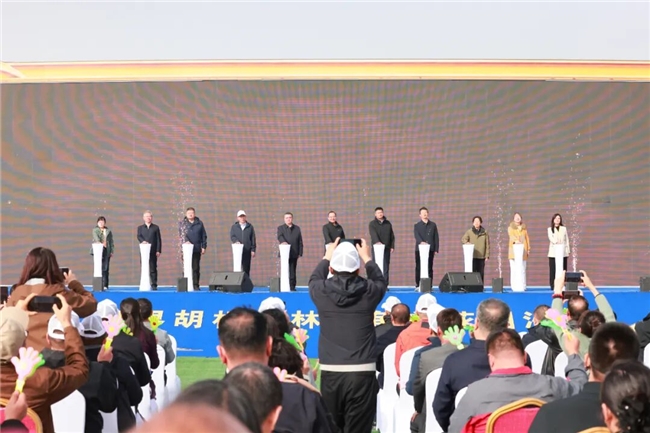
The site of the 16th Desert Poplar Cultural Tourism Season of Shaya County and the "Eco-Shaya · Life of Cistanche" Eco-Agricultural Products Exchange Conference. Photo by Aynurgul Tohti
The opening ceremony began with the opening dance "Ode to the Desert."
In his address, Eli Bext, Deputy Secretary of the CPC Shaya County Committee and Head of Shaya County, said that Shaya is now at a critical stage of pursuing high-quality development and advancing toward common prosperity. "We are committed to turning our ecological resource advantages into economic development advantages, vigorously developing industries such as oil and gas chemicals, textiles and apparel, new energy, new materials, and specialty agriculture and deep processing, and — with the desert poplar as our medium and cistanche as the bond of friendship — sharing the opportunities of green development, so that the 'desert poplar brand' resounds ever louder and the 'story of Shaya' becomes ever more moving," he said. "We firmly believe that, under the strong leadership of the regional and prefectural Party committees, with the care and guidance of leaders at all levels, the selfless assistance of the paired-up partner province, and the vigorous support of all sectors of society, Shaya will safeguard its million mu of desert poplar forests, cultivate its eco-industries, carry forward the cultural heritage of ancient Qiuci (Kucha), and deliver on the people's aspirations — tilling on in the spirit of the desert poplar and building on momentum, so that the oasis amid the vast sands remains forever green."
Sheng Xiuping, Member of the CPC Aksu Prefectural Committee and Head of the Prefectural Publicity Department, delivered a speech. Wu Hongzhan, Secretary of the CPC Aksu Prefectural Committee, along with leading officials of the autonomous region's and Aksu Prefecture's departments of agriculture and rural affairs, forestry and grassland, and culture and tourism, experts and scholars in the field of cistanche, and representatives of specialty agricultural product enterprises and exhibitors attended the event.
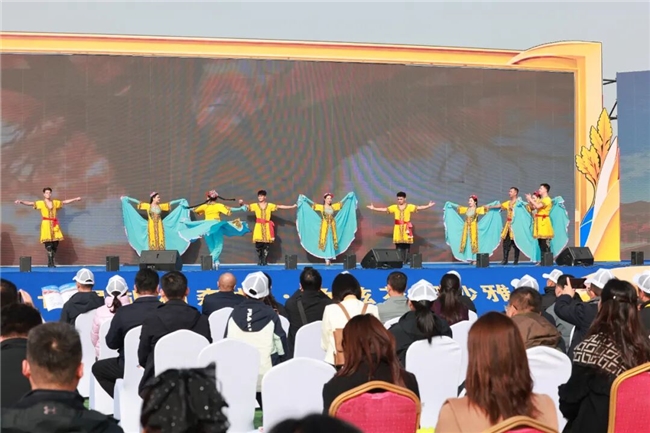
The site of the 16th Desert Poplar Cultural Tourism Season of Shaya County and the "Eco-Shaya · Life of Cistanche" Eco-Agricultural Products Exchange Conference. Photo by Aynurgul Tohti
During the arts performances, song and dance numbers, instrumental music, choral pieces and other programs were presented in turn by local troupes and amateur performers. Dressed in festive costume, the artists gave wholehearted performances on the stage amid the desert poplar forest, blending rich local flavor with an uplifting spirit of the times. Spectators sat around the stage, taking out their phones from time to time to take photos and record videos, with waves of applause and cheers — a lively scene that showcased the upbeat outlook of Shaya's people of all ethnic groups.
Gao Jie, a visitor from Shanghai, said: "Coming to Shaya today, I find this desert poplar forest really impressive, and the lake is vast — for photography enthusiasts like us, it is a delight, and I've taken photos I'm very happy with. The place is bustling with visitors. I'm glad to be here; we feel very satisfied and truly awestruck. Some of these sceneries are unlike anything I've ever seen before."
Yang Mei, a visitor from Sichuan, said: "We chartered a coach, a group of 36, and came to the beautiful Shayanzhou. There are large-scale arts performances here, and Shayanzhou's most distinctive features are the waterside desert poplars and the desert poplars in the sand dunes — they are extraordinarily beautiful, and right now is the very best time to view them. Besides admiring the magnificent desert poplars, you can also enjoy superb food here — grilled fish and tamarisk-skewered barbecue are the biggest draws for visitors."
At the opening ceremony, Shaya County presented plaques to businesses rated as four-star tourist hotels and four-star farm restaurants, pushing tourism reception services to higher quality. The county also released the Achievements of the Shaya Intangible Cultural Heritage Digitization Project, showcasing its digital explorations in protecting and passing on the county's intangible cultural heritage.

A vendor introduces cistanche and other Shaya specialty products to visitors. Photo by Aynurgul Tohti
The promotion of the cistanche industry was the highlight of the conference and a vivid snapshot of Shaya's path of coordinating ecology and industry. In recent years, seizing policy opportunities, Shaya has built 360,000 mu (24,000 hectares) of ecological cistanche plantations with an annual output of 30,000 tonnes; the deep-processing enterprises it has attracted have developed 17 cistanche products, with output value exceeding 200 million yuan, achieving a "win-win" of sand stabilization and income growth. Thanks to its outstanding quality, Shaya cistanche has been listed in the National Catalogue of Famous, Special and Excellent New Agricultural Products and on the national "One County, One Product" list of authentic medicinal materials, earning a national-level quality accolade — a true "desert ginseng" grown out of the boundless sand sea.
Liu Yongping, a researcher at the Desert Control Research Institute of the Xinjiang Academy of Forestry Sciences, said: "Two-thirds of Shaya County's land area is sandy desertified land, offering vast land resources for growing cistanche. The county's climate is rather distinctive and suits the growth of cistanche. Most notably, there are large reserves of brackish groundwater beneath the surface. Because of irrigation with this brackish water, the physiological response of the cistanche leads to a greater accumulation of active compounds — that is, of its enzymes — so the quality of Shaya's cistanche is particularly rich in the active ingredients valued in traditional Chinese medicine."
In the eco-agricultural products exhibition area, Shaya's specialty farm products, led by cistanche, were on concentrated display, with exhibitors explaining on site the products' features, processing techniques and nutritional value, and many visitors stopping to taste, ask questions and buy. In the intangible cultural heritage area, Shaya knives, Karakul lamb-fur hats, painted woodware and other heritage crafts were neatly arranged, drawing visitors to experience them up close.
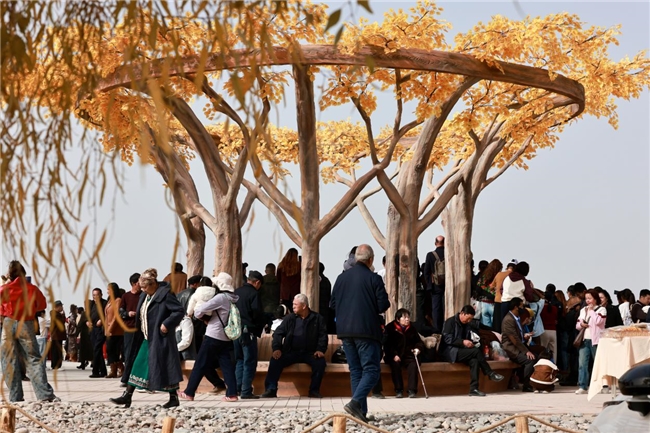
The photo checkpoints were bustling with visitors pausing to rest and enjoy the autumn scenery. Photo by Aynurgul Tohti
Wang Congheng, a visitor from Shanxi, said: "Before coming, all I knew was that Shaya has desert poplar forests — I never imagined it also has so many eco-agricultural products. After watching today's presentation, I learned that treasures like cistanche and Apocynum honey actually grow in sandy land and have developed through ecological restoration. I knew far too little about Shaya before; today's presentation gave me a much fuller picture of the county. This trip has been well worth it — back home I'll tell my friends all about Shaya."
To one side of the stage, a fashion show was in full swing. Models appeared one after another in distinctive costumes, walking with poise and striking poses on the runway beside Poplar Lake, the patterns on their garments playing delightfully against the golden hues of autumn. Audience members raised their phones to take photos and videos, and many visitors stopped to watch with their children, as applause and camera shutters sounded in waves, adding to the festive atmosphere.
Deng Lin, a visitor from Hunan, said: "We're from Hunan. Today we came to the Shaya desert poplar forest — the scenery here is gorgeous and we took lots of photos; every shot is a keeper. We also got to eat baked buns today — so delicious! I recommend everyone come visit Shaya."
This year's Desert Poplar Season adhered to the principles of a lean event, ordinary people as the protagonists, and ecology benefiting the people: no lavish staging and no celebrity guests. The 16 themed events were made possible through Hubei's pairing-assistance resources in Xinjiang, university student clubs, and programs staged by local folk artists. Focusing on the main thread of benefiting the people and highlighting the public's central role, the events let ordinary residents be both audience and participants. Meanwhile, university student clubs were organized to visit local schools and talk face to face with young people, conveying positive values and using culture-and-tourism events to energize the city and benefit residents.
上一篇:山海不负赶路人——滇籍务工者深耕珠江西岸滨海建设三十余年岁月印记
下一篇:没有了